MegaShot Pickl+
Taking an interactive connected sports product from hardware prototyping to global launch.
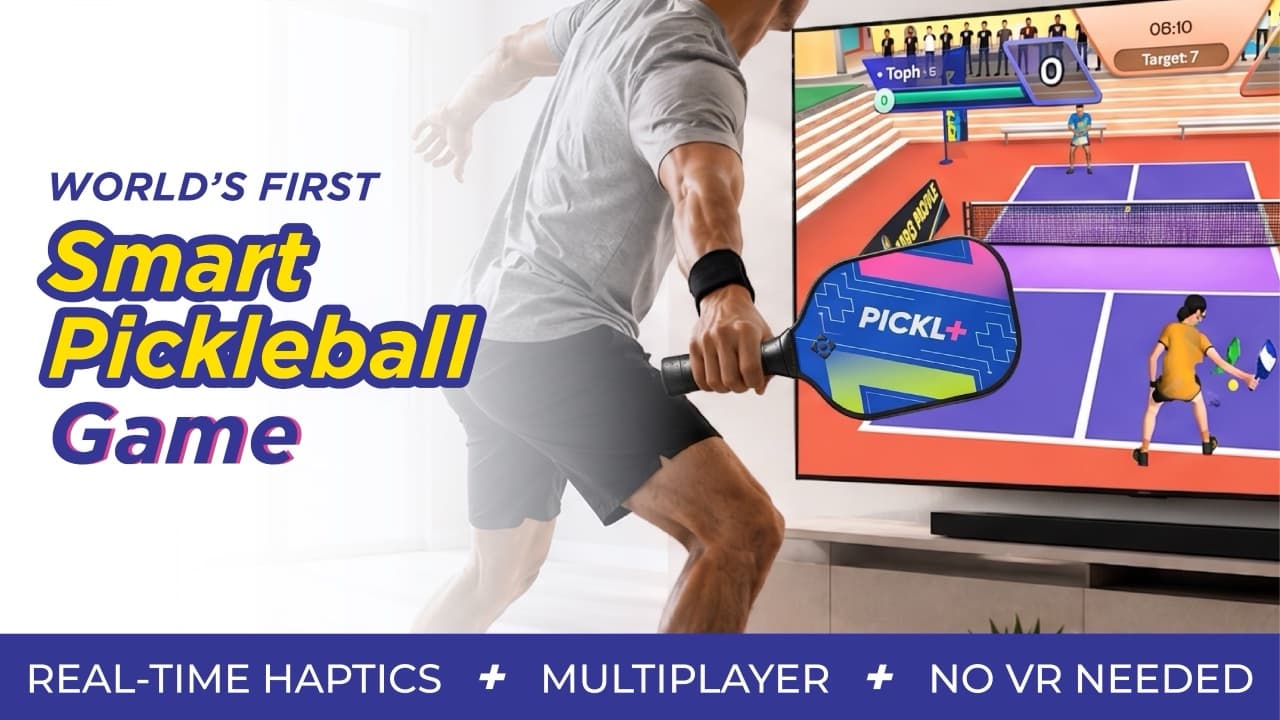
A motion-sensing smart pickleball paddle with connected software for interactive at-home gaming. Combining physical sensor data, low-latency mobile software, and go-to-market execution.
The Product & Target User
MegaShot Pickl+ is a motion-sensing smart pickleball paddle with connected software designed for interactive at-home gaming. It bridges physical sports hardware with digital gameplay, allowing players of all skill levels to play real pickleball swings in their living room without requiring VR headsets, dedicated gaming consoles, or specialized court access.
The Target User: Recreational pickleball enthusiasts, families, and gamers seeking active at-home play, as well as players who want to practice stroke mechanics, swing velocity, and shot timing when outdoor courts are inaccessible due to weather, distance, or court congestion.
The Value Proposition: Bringing real physical racket sports into the living room at a fraction of the cost and setup friction of traditional console setups. A player picks up a lightweight, authentic paddle, pairs it via Bluetooth to a smartphone, tablet, or TV, and immediately steps into interactive drills, target games, or head-to-head matches.
Why Cross-Functional Coordination Is Critical: Building Pickl+ required tight synchronization across four distinct disciplines:
- Physical HardwareSensor placement, 300g weight balance, battery layout, and handle haptic vibration mechanics.
- Connected SoftwareLow-latency BLE streaming, packet buffering, and stroke classification algorithms.
- Gameplay ExperienceHit detection windows, game modes (practice, streak, career), and tactile visual feedback.
- Launch & GTMCrowdfunding campaign structure, product positioning, media coverage, and early backer engagement.
The Problem Space & Experience Constraints
Pickleball is among the fastest-growing sports globally, yet players face real access constraints: overcrowded public courts, weather dependencies, and a lack of engaging solo practice solutions. Traditional video games offer button-mashing or camera-based tracking that lacks tactile racket feel, while VR headsets cause disorientation, isolate the player from family members in the room, and carry high entry costs ($400+).
Critical Experience Constraints:
- Latency Sensitivity: A physical swing takes under 300ms from backswing to follow-through. Any perceptual lag over ~80ms between the physical wrist snap and digital ball strike destroys the immersion.
- Living Room Ergonomics: The device had to be safe for typical apartment ceilings and living rooms without requiring complex optical calibration cameras.
- True-Feel Weight & Balance: Unlike lightweight plastic game controllers, the paddle needed the genuine weight (~300 grams) and weight distribution of an actual USAP pickleball paddle.
- Zero-Console Barrier: Users should not need an Xbox, PlayStation, or gaming PC; pairing directly with everyday smartphones, tablets, or laptops was essential for adoption.
Responsibilities Breakdown
Working across cross-functional streams does not mean individual sole authorship; contributions are strictly delineated below.
Owned
Decisions & deliverables with direct individual ownership:
- Authoring functional product requirement documents (PRDs) for swing classification and user feedback states.
- Designing user flow specifications connecting BLE pairing directly into gameplay rounds.
- Structuring user testing protocols and recording stroke response telemetry during test sessions.
- Formulating technical positioning and core capability claims across public communication materials.
Led
Workstreams led collaboratively across disciplines:
- Sprint prioritization aligning hardware sensor firmware milestones with mobile client releases.
- Evaluation of stroke classification thresholds between drives, volleys, and drop shots.
- Crowdfunding page content structure, feature storytelling, and backer FAQ architecture.
- Product review sessions translating user friction into concrete engineering backlog tickets.
Contributed to
Work performed collaboratively with wider team:
- Physical paddle balance testing, industrial grip ergonomics, and weight distribution reviews.
- Haptic vibration curve tuning to match virtual ball contact sensation.
- Creator outreach lists, community engagement, and launch day campaign monitoring.
- Hardware Bill of Materials (BOM) cost sensitivity analyses and packaging specifications.
Product Decision Stories
Real engineering and product trade-offs evaluated during prototype development.
1. Direct-to-Device BLE Connection vs. Dedicated TV Console Hub
Architecture & BOMThe Problem: How to transmit motion sensor readings to the player's screen with low latency while avoiding high retail hardware costs.
Options Considered: (A) Building a dedicated HDMI receiver/console plug for the TV, or (B) Direct Bluetooth Low Energy (BLE) pairing to user phones/tablets/laptops with HDMI/AirPlay screen mirroring.
Constraints: Hardware BOM targets ($175–$249 retail ceiling), regulatory certifications for proprietary receivers, and cross-platform mobile compatibility.
Why Selected: Direct BLE pairing removed the cost and supply-chain risk of manufacturing custom TV dongles. Users could download the companion application onto their existing devices immediately.
Outcome & Remaining Uncertainty: Successfully lowered barrier to entry; ongoing optimization is required for BLE packet consistency across varied Android hardware chipsets.
2. Edge Microcontroller Feature Streaming vs. On-Paddle Model Inference
Embedded vs RuntimeThe Problem: Deciding where kinematic stroke interpretation should occur inside the paddle firmware or in the host mobile application.
Options Considered: (A) Running full classification models on an embedded MCU on the paddle, or (B) Streaming calibrated sensor streams to the connected smartphone runtime.
Constraints: Battery capacity (2000 mAh target for 4+ hours gameplay), paddle thermal limits, and firmware update complexity.
Why Selected: Streaming filtered sensor packages over BLE allowed the paddle firmware to remain lightweight, thermally cool, and power-efficient, while enabling rapid over-the-air updates to the swing classification algorithms in the mobile app.
Outcome & Test: Preserved 4–5 hour continuous battery endurance while enabling rapid algorithm iteration without requiring risky hardware firmware re-flashes.
3. Synchronized Handle Haptics for Tactile Hit Confirmation
User ExperienceThe Problem: In initial digital swings, players felt a sensory disconnect without physical ball resistance, reducing immersion and timing accuracy.
Options Considered: (A) Audio and screen effects only, vs. (B) Integrating a dedicated vibration actuator in the paddle handle triggered upon stroke contact.
Constraints: Microcontroller actuation delay (<40ms), motor power draw, and physical vibration dampening through the paddle handle wrap.
Why Selected: Immediate tactile handle feedback simulated the physical impact of a ball, significantly enhancing player immersion and swing rhythm.
Outcome: Marked improvement in perceived realism during testing; calibration of vibration amplitude between soft dinks and power smashes remains an active tuning area.
Launch Execution & Timeline
Motion Sensor Integration & Gameplay Feasibility
Conducted early player feedback rounds, testing sensor latency, paddle grip ergonomics, and stroke interpreter accuracy across prototype revisions.
New York Toy Fair Showing
Premiered MegaShot Pickl+ on the sidelines of the New York Toy Fair (Booth 6619, covered by People of Play), presenting live interactive paddle demos to industry reviewers and retail partners.
Kickstarter Campaign Launch
Launched the public Kickstarter campaign with tiered backer rewards, product explainer videos, and interactive gameplay breakdowns.
Featured on Pickleball.com
Featured on Pickleball.com highlighting the world’s first smart pickleball game combining real-world gameplay mechanics with connected digital interactions.
Attributable Launch Results
Results are reported based on verified company milestones and public documentation.
Campaign reached 500% of its goal within 24 hours (company-reported).
Featured on Pickleball.com: "World’s first smart pickleball game launched by MetaShot".
User Testing & Iteration Cycle
Documenting concrete changes driven by early tester feedback.
Early testing sessions revealed critical usability friction points that directly altered our product requirements and firmware logic:
Gentle drop shots and kitchen dinks were initially discarded by the stroke classifier as incomplete swings due to high velocity threshold cutoffs.
After: Dynamic Velocity FloorIntroduced an adaptive acceleration curve that recognizes low-amplitude wrist angles, reliably detecting delicate dinks.
Testers reported forearm strain after 15 minutes of continuous play because early battery placement leaned heavily toward the handle base.
After: Center-of-Mass RebalancingShifted the internal 2000 mAh battery pack closer to the paddle neck, establishing balance identical to regulation paddles.
Retrospective & Engineering Lessons
Honest operational reflections from early-stage connected hardware development.
1. Earlier Cross-Manufacturer Android Bluetooth Benchmarking
While iOS BLE connections operated with uniform latency, varied Android chipsets and OEM battery optimization profiles introduced intermittent packet buffering. In future hardware projects, I would build an automated multi-device BLE test matrix earlier in the prototype phase.
2. Automated Robotic Swing Rig for Continuous Regression Testing
Relying solely on manual human swings during early testing caused variability when comparing firmware revisions. Building a standardized mechanical pendulum or robotic test arm would have eliminated human swing inconsistency during calibration.
3. Tighter Pre-Launch Telemetry Instrumentation
Instrumenting detailed anonymous swing error logging in early alpha builds would have accelerated identifying edge cases like left-handed topspin slices prior to broad beta playtesting.
System Architecture & Verified Resources
Implemented runtime architecture distinguished from planned multi-sport expansion.
pickleball.themegashot.com
Live Kickstarter Campaign
Pickleball.com Feature
Connect on AI & Connected Hardware