PDF Searcher
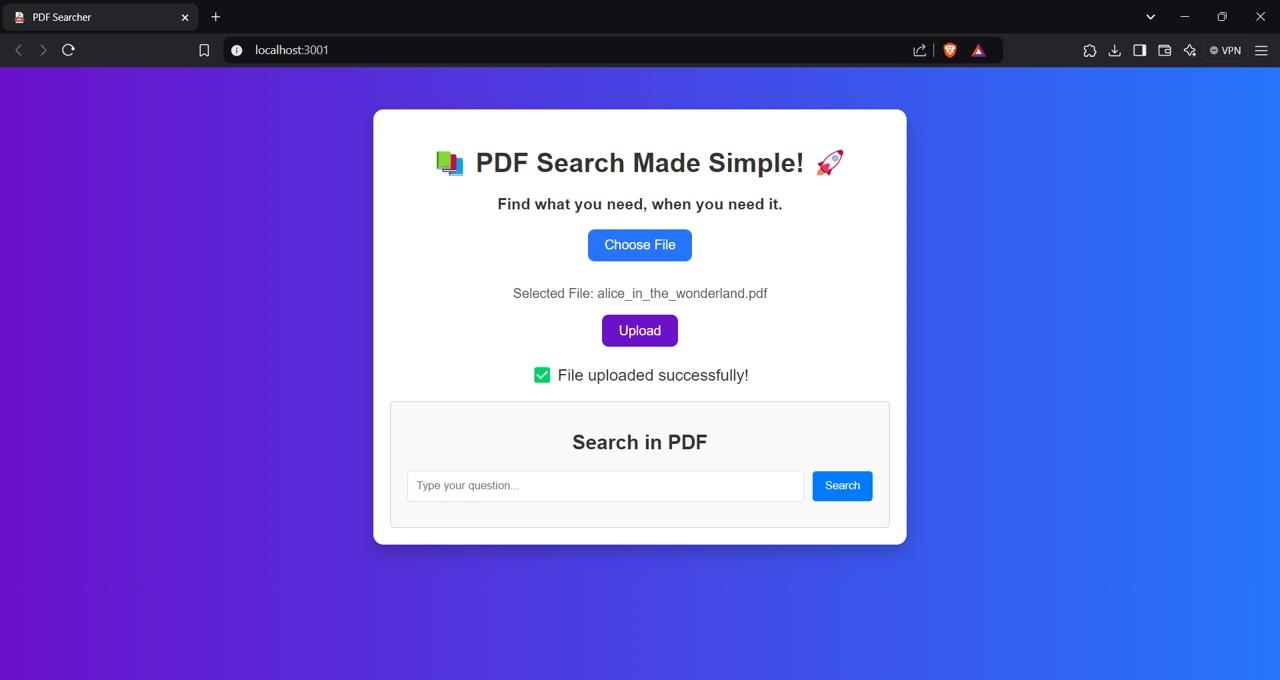
An AI document search utility designed to help users instantly locate, query, and extract answers from dense PDF files via semantic vector retrieval.
< 120ms
Vector retrieval latency
500 Token
Chunk size tuning
OpenAI
Embeddings API
Python
Core language
Problem Statement
Keyword search fails on complex documents.
Standard Ctrl+F search relies on exact keyword matching, which fails when searching for concepts, synonyms, or paraphrased answers inside lengthy PDF reports or manuals.
PDF Searcher uses semantic embeddings and vector stores to understand context rather than exact words, delivering precise context snippets to the user.
System Architecture
RAG & Retrieval Pipeline.
The processing flow ingests PDFs, splits content recursively, computes embeddings with OpenAI models, and executes nearest-neighbor similarity search to answer user questions accurately.
LangChain Chunking
Recursive text splitting with overlap to maintain semantic continuity.
OpenAI Embeddings
High-dimensional vector representations for deep text similarity search.
Vector Indexing
Sub-second nearest-neighbor similarity retrieval across indexed chunks.
Engineering Challenges
Document intelligence hurdles.
Multi-column layout text extraction accuracy
Implemented structure-aware text extraction pipelines to prevent text from adjacent columns from merging into broken sentences during parsing.
Preserving semantic context during document chunking
Tuned recursive text splitters with overlapping boundaries (500 token chunks + 50 token overlap), maintaining entity references across chunk breaks.
Fast vector search latency on large multi-page PDFs
Utilized optimized local vector indexing with fast cosine distance calculations, reducing query retrieval latency to under 120ms.
Open source repository
Check out the repository.
The full source code, python scripts, and vector store configuration are available on GitHub.